

Dr Leo Bauer
“Civilians embedded in the same networks as rebel fighters can better gauge rebel behavior through shared contacts and thus adapt their survival strategies, and can leverage shared norms to constrain rebel conduct.”
Some rebel groups emerge from the very communities they seek to control, built by neighbors, kin and former co-workers who took up arms together. Others enter communities as outsiders, with no prior relationship to the civilians they govern. This distinction between rebels with and without social ties to civilians has received surprisingly little systematic attention in the civil war literature. In this blog post I contribute to advancing relational approaches to civil war by outlining the concept of rebel-civilian social ties, illustrating how these ties shape the dynamics of armed conflict through interviews with Syrian civilians who lived under rebel rule, and presenting original cross-national data on their global prevalence.
Rebel-civilian social ties refer to the bonds between civilians and rebel combatants originating from the same community. Such a community may be a village, town, neighborhood or a small cluster thereof. These bonds are the product of continuous, intergenerational cohabitation and are composed of three main elements. First, they entail personal ties and trust, built through repeated everyday interactions among individuals who know each other and can verify each other’s backgrounds through overlapping social networks. Second, they comprise a shared sense of belonging, local identity and community solidarity, rooted in common history, culture and heritage. Third, they entail shared norms and values, which manifest in informal institutions such as community leaders, tribal authorities, or local councils that structure communal life and arbitrate disputes.
What Are Rebel-Civilian Social Ties?
This concept is related to, but distinct from, adjacent ideas in existing literature. Social endowments, as theorised by Weinstein, conceive of civilian communities mainly as a resource for rebels to recruit committed fighters. Social network scholars have linked rebels’ prewar social embeddedness to group formation, cohesion and resilience, but again primarily from the rebels’ point of view. My conceptualisation of social ties differs in that it is explicitly relational: social ties shape civilian behavior in conflict as much as they shape rebel behavior. Civilians embedded in the same networks as rebel fighters can better gauge rebel behavior through shared contacts and thus adapt their survival strategies, and can leverage shared norms to constrain rebel conduct.
Investigating Social Ties: A Mixed-Methods Approach
To investigate rebel-civilian social ties I combine two sources of evidence. First, I code a binary social ties variable for all state-rebel dyads listed as active in intrastate conflicts in the Uppsala Conflict Data Program between 1990 and 2018, drawing on a variety of sources including conflict encyclopedias, dataset coding notes, scholarly works, NGO reports and news articles. A rebel group is coded as having social ties if, at rebellion onset, the majority of its leadership and fighters originate from a geographically delimited locality and the group’s main area of operations is around that same locality.
Second, I conducted in-depth interviews with Syrian civilians, who experienced armed group rule during the Syrian civil war. Syria offers a particularly valuable setting for studying social ties, as it saw groups with and without ties operating simultaneously in the same conflict. Applying the coding criteria outlined above, Free Syrian Army (FSA) factions whose leadership and fighters originated from and operated in the same locality are classified as having social ties, while the Islamic State (IS), whose leadership and fighters were overwhelmingly of non-local origin, is classified as having no social ties. Participants’ accounts of living under rebel rule allow me to trace the relational dynamics that the cross-national data cannot capture.
What the Evidence Shows
Interviews with Syrian civilians who lived under rebel rule illustrate how social ties shape civilian-rebel relations in practice. Under locally-embedded FSA factions, shared networks allowed civilians to gauge rebel behavior and adapt accordingly. A civilian from a town in the Aleppo countryside, where two FSA brigades operated simultaneously, could distinguish between them precisely because of being acquainted with fighters prior to the conflict: “In our town there were two FSA brigades: one was fighting Assad and the other was just stealing from people and engaging in corruption. But we knew who of them we could trust.”[1] Shared norms and community identity also gave civilians leverage to constrain rebel conduct. For example, in Douma, where Jaysh al-Islam was mostly composed of local fighters, civilians used public pressure to impose reputational costs on the group for misconduct, making the group more cautious in its approach to civilians. Where social ties were absent, none of these channels existed. IS, composed overwhelmingly of fighters and leadership with no prior ties to Syrian communities, offered civilians no personal ties or shared networks to draw on, no common identity to invoke and no informal institutions through which to channel grievances. A civilian from Deir Ezzor captured the difference directly: “During the rule of the Free Syrian Army, life was simpler because we knew who we were governed by. On the other hand, life with IS was terrifying because people were frightened of any daily detail or behavior, thus life was extremely hard.”[2]
Looking Forward
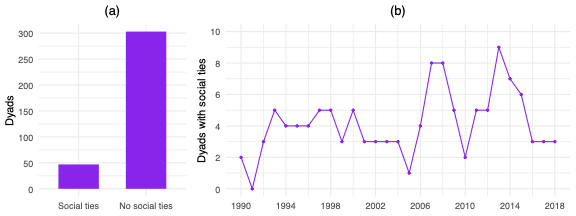
While the Syrian evidence illustrates how social ties shape civilian-rebel relations, my cross-national data reveal the broader prevalence of this phenomenon. As the figure shows, of the 358 groups coded, only 13% had social ties at rebellion onset. This may be attributed to the often multi-year lag between rebel group formation and rebellion onset during which many groups transform organisationally, diluting their local character before they enter the dataset. This process remains understudied. The prevalence of groups with social ties nonetheless grows over the period covered, a trend that also merits further examination.
My evidence also points to an important avenue for further research: the effects of social ties on civilian protection are unlikely to be uniform within communities. Civilians’ ability to gauge rebel behavior and leverage shared norms to constrain rebel conduct depends on their position within the community’s social structure, including their family networks, gender and social standing. Future research should examine the conditions under which social ties afford more or less protection to different civilian groups and what this means for how the social roots of rebellion shape the experience of war.
[1] Civilian interview, Turkey, 2025.
[2] Civilian interview, Turkey, 2025.